Tuesday, July 20, 2010

Field Report: Amazon Watch Campaigners in Ecuadorean Region Devastated by Chevron

The Oriente – the East – is Ecuador's Amazon rainforest region, home to unparalleled biological diversity, as well as the country's oil patch and massive contamination left behind by decades of oil operations by Texaco (now Chevron). Amazon Watch's Ecuador campaign team is on a brief field research mission in the Oriente, and today was a full day investigating former Chevron oil well sites, abandoned toxic waste pits, and visiting with community members affected by oil pollution. We're basing out of oil boom town Lago Agrio – "sour lake" – named for Sour Lake, Texas where Texaco was founded. Beginning as a base camp for Texaco, Lago Agrio is in the center of what used to be the Amazon rainforest in northeast Ecuador, only about a dozen miles from the Colombian border.

Today was only our first day out in the field on this visit, inspecting oil extraction sites and contamination, shooting photos and video, and conducting interviews and research. We're here for the next week and while we have a busy schedule, we'll try to report back here about some of the places we discover, some of the people we encounter, and some of the stories we hear.

We started off the day with a brief visit to Pablo Fajardo, lead attorney for the 30,000 people who are plaintiffs in the lawsuit demanding full clean-up by Chevron of its contamination in the region, as well as compensation for the horrific impact the company's legacy has had – and continues to have – on the lives and livelihoods of the affected communities. Sitting in his office, he was dwarfed by a portion of the legal documents from the 17-year legal battle to hold Chevron accountable.

After leaving Lago Agrio, our first stop this morning was Chevron/Texaco's fifth exploratory oil well site, so-called Lago Agrio #5, or Lago cinco. We checked out a waste pit that Chevron claims was remeditaed, and dug up black, gunky petroleum from only a couple feet beneath the surface of the ground. Sadly, it also came up with a bunch of water as the water table is very high here, with tons of rain, and primarily sandy, permeable earth. We met a couple who lives mere yards from the pit and who told of various health problems that ail their family and neighbors.

We then took a trip to the second well drilled by Texaco/Chevron, called Lago Agrio #2, or Lago dos. There, we investigated another of the toxic waste pits that Texaco claims to have remediated, finding more crude just beneath the surface, abandoned to leech into the groundwater of people living nearby. There, our friend and guide, Donald Moncayo, explained how he was born only a few yards from the spot where he dug his auger into the ground to pull up the toxins. In fact, the waste pit was on his family's land.

With a furrowed brow, Donald told us how his mother died after bathing in a polluted stream. A tumor on her back suddenly became unbearably painful and horribly inflamed only hours after coming into contact with the toxic water. As she became gravely ill, the family summoned a local doctor who rushed over. Shocked, he told Donald's mother, "you've been poisoned." She succumbed within hours. Donald had two brothers – twins – who died five months apart while still babies. His adult sister had an operation in 2006 for a brain tumor and is still undergoing chemotherapy in Quito.

While these stories are disturbing and tragic, it's impossible not to be inspired by Donald's commitment to seeking justice for all of the people affected by Chevron's devastation of the Ecuadorean Amazon.

Donald was taking us around today as a friend and ally, but also as an activist with the Amazon Defense Coalition. He has become profoundly knowledgeable about the contamination sites and the people affected and is constantly taking journalists, scientists, activists, and others out to see Chevron's toxic legacy in the Amazon.

As we were visiting Donald's family's land at Lago #2, a family friend, Don Bresillo, walked up. Don Bresillo's land is adjacent to that of Donald's and he was friends with Donald's late father. We spent some time with Don Bresillo and learned the history of the surrounding area from when he arrived in 1970, when it was still the traditional hunting grounds of the Cofan tribe.

From there, we continued on, southeast of the huge 'Lago Agrio' oil field, across the Aguarico river, and to the 'Aguarico' field. We visited Aguarico #4 well site, now being used by Ecuadorean national oil company Petroecuador to reinject the toxic wastewater byproduct of oil drilling back deep underground.

Chevron likes to try to shift blame for the devastation in the Amazon to Petroecuador and in the next post, we'll look closely at the toxic wastewater (waters of formation, or produced water) and who is to blame for the poisons in the environment we saw, smelled, and touched today.

As dusk descended on the field next to the well at Aguarico, and bugs began nibbling at our ears and necks, we bundled back into our van to head 'home' to Lago Agrio. With stories of suffering on our minds and the smell of toxic pollution still in our noses, we pulled up to the bank of the Aguarico river. As the ferry took our van back across the river, the last remnants of a beautiful Amazon sunset lifted our heavy hearts and reminded us of all we have to be grateful for.

– Han

Han Shan is the Coordinator of Amazon Watch's Clean Up Ecuador Campaign

Friday, July 16, 2010

Chevron Swift Boat Tactics Prevail: Appeals Court Orders Filmmaker to Turn Over Ecuador Footage

After a court hearing yesterday in the legal battle between Chevron and filmmaker Joe Berlinger, a 3-judge appeals panel has issued a disturbing ruling.

According to The Los Angeles Times:

A federal appeals panel has ruled quickly that though Joe Berlinger does not have to surrender all 600 hours of outtakes from his film "Crude" to Chevron Corp., the documentary filmmaker must immediately hand over several categories of unused film footage.

The article goes on to explain what the court is ordering turned over:

While the judges said a full opinion would follow, they did order that Berlinger give Chevron footage not appearing in "Crude" showing counsel for the plaintiffs in the environmental lawsuit (who discuss trial strategy in the film); experts in the proceeding (some of whom Chevron has accused of partiality); and current or former Ecuadorean government officials (which the oil company says colluded with the plaintiffs' lawyers).

Importantly, the ruling also confined Chevron's usage of the footage to litigation, arbitration, or submissions to official bodies, explicitly preventing the company from using the footage for publicity purposes.

Berlinger, his attorney Maura Wogan, and prominent First Amendment lawyer Floyd Abrams – who wrote a high-profile friend-of-the-court brief in support of Berlinger's fight to protect his footage – all made cautious statements about being pleased with the ruling. While it's clear that the appeals panel significantly narrowed the original order by District Judge Lewis Kaplan, and upholds the principle that a documentary filmmakers' outtakes are protected journalistic materials, it's hard not to see this as another victory for what I called Chevron's "Swift Boat Tactics" in a previous post on this blog.

In a statement released after the hearing yesterday (but before the panel's ruling later in the day), attorneys for the 30,000 indigenous people and campsesinos in Ecuador's Amazon rainforest who continue to suffer from Chevron's oil contamination, said:

Chevron's legal theatrics in New York are part of a larger strategy created to evade responsibility for creating the world's worst and longest-lasting environmental catastrophe. Today's hearing was part of a much broader effort by Chevron to launch multiple litigations in various states and countries to hide the company's massive legal and reputational problems in Ecuador from its own shareholders, employees and the public. One thing that is certain is that Berlinger's video outtakes, just like the material in Crude, contain even more evidence that Chevron engaged in reckless misconduct in Ecuador and then concocted a fraudulent cover-up to conceal it from authorities.

Evidence from the trial shows that Chevron – in the form of wholly-owned subsidiary Texaco – poisoned a large swath of formerly-pristine rainforest in Ecuador's Amazon region, leading to skyrocketing rates of cancer and other oil-related illness for tens of thousands of residents. Chevron's own audits disclose the company deliberately dumped billions of gallons of toxic wastewater directly into rivers and streams in order to cut costs. The company also dumped millions of gallons of crude and abandoned hundreds of open-air, unlined toxic waste pits in the midst of communities who suffer the results of contamination that continues to leech into soil and groundwater.

Facing the mountains of incontrovertible evidence of its responsibility for massive suffering in Ecuador, Chevron is trying to shift the entire fight to new battlegrounds.

Because its guilt is so obvious, Chevron instead focuses on attacking the legal process in Ecuador, questioning the motives of those trying to hold the company accountable, and using every legal and PR trick in the book to delay a verdict in the trial, distract the public and its shareholders from its liability in Ecuador, and drain the resources of the people demanding full cleanup of its oil pollution.

With this latest ruling, Chevron has further refined its dishonest and abusive strategy for evading accountability, but the people in Ecuador are far from giving up.

– Han

Han Shan is the Coordinator of Amazon Watch's Clean Up Ecuador Campaign.

Thursday, July 1, 2010

VIDEO: Day 1 of Ecuador Delegation to Gulf Coast & Al Jazeera Report

Check out this video of Day 1 of the Ecuadorean delegation to the Gulf Coast, supported by Amazon Watch and our allies at Rainforest Action Network. The video was shot and edited by Dominic Howes of Rikshaw Films:

Al Jazeera English covered the delegation, and their strong report includes some footage from the Ecuadorean Amazon as well:


I hope you'll share these videos with your friends and family and via your social networks. I posted these videos to Amazon Watch's Facebook page– visit our page to share from there.

– Han

Han Shan is Coordinator of Amazon Watch's Clean Up Ecuador Campaign.

Wednesday, June 30, 2010

Photo Essay: Ecuadorean Delegation Tours BP’s Oil Disaster in the Gulf

Amazon Watch is supporting the Ecuadorean delegation to the Gulf Coast this week along with our allies at Rainforest Action Network (RAN). RAN's Jon Mcintosh posted a powerful photo essay of our first day out on the Gulf Coast on the Change Chevron blog. I've re-posted the essay in its entirety below:

On Tuesday, June 29 Houma and Grand Bayou American Indian leaders showed Ecuadorean leaders the impact of BP's oil disaster on their coastal communities. The boat left from Port Sulphur and visited devastated wetlands, oil soaked wildlife, and the Grand Bayou village.

The Indigenous Ecuadorean leaders are in the Gulf coast to meet with American Indian tribes in the Gulf region and share their experiences coping with decades of Chevron's massive oil contamination in their home.

Ecuadorean Indigenous Leaders Visit Gulf Coast Oil Impacted Communities
Emergildo Criollo (right) is a leader of the Cofan tribe in Ecuador's Amazon Rainforest. Humberto Piaguaje (left) is the representative of the Secoya people to the Assembly of Delegates of Communities Affected by Chevron/Texaco.

Oil spill boat trip with Houma and Ecuadorean leaders
Michael Dardar, Vice Principal Chief of the United Houma Nation sits with Emergildo Criollo, Humberto Piaguaje, Mariana Jimenez as they take a boat trip into the marshland to see BP's oil disaster.

Houma and Ecuadorean leaders Tour the Gulf Oil Spill
Local resident Philip Simmons takes Houma and Ecuadorean leaders in his boat to see BP's oil disaster.

On the Boat to Bay Baptiste
Mariana Jimenez on the boat ride leaving from Port Sulphur heading out to Bay Baptiste. She is a 71-year old grandmother from near Lago Agrio, Ecuador. Her home was soon surrounded by oil spills and contamination. Her husband, who worked for Texaco (now Chevron), and her sister, both died of cancer.

Oil in Louisiana’s Bay Baptiste
Oil contaminates the wetlands in Louisiana’s Bay Baptiste.

Oil near Grand Bayou, Louisiana
An oil boom laying in the marshland grass with oil on both sides.

Oil in Louisiana’s Bay Baptiste
Thick brown oil covers marshland grass while oil sheen floats on top.

Mariana Inspects the oil spill
Mariana inspects the oil spill saying the smell and feel of the oil reminds her of the oil contamination left by Chevon (formally Texaco) in her Amazon home.

Mariana Inspects the oil spill
Mariana's oil coated hand after picking a blade of grass from the mash.

Humberto Piaguaje inspects BP's oil disaster
Humberto Piaguaje inspects BP's oil disaster in the marshlands.

Rosina Phillipe of Grand Bayou Nation welcomes Ecuadorean leaders

Rosina Phillipe of Grand Bayou village welcomes Ecuadorean leaders to her home on the water.

Rosina Phillipe talks about oil impact on her community
Rosina Phillipe and the delegation share stories and lessons learned from living with oil contamination. (From left: Rosina Phillipe, Maria Ramos, Matiana Jiminez, Mitch Anderson, Humberto Piaguaje, Emergildo Criollo)

Emergildo Criollo on the way to Grand Bayou  Village
Emergildo Criollo in the boat leaving Grand Bayou Village.

Monday, June 28, 2010

Amazon Indigenous Leaders Bringing Lessons for Coping With Oil Disasters to Native Residents of U.S. Gulf Coast

Four very different people arrived last night in New Orleans on a late flight from Quito, Ecuador. One is a quiet but fierce 71-year-old grandmother with 27 grandchildren. Another is a gentle, soft-spoken man who is a leader of his Indigenous tribe from the Amazon. Another is a serious and sober man who has won worldwide acclaim for his unique work. And the last is another Indigenous man from the Amazon, who is more sharp-tongued than his traveling companion, but shares his good humor and dignified demeanor.

The four Indigenous and community leaders from Ecuador's Amazon rainforest are on the front-lines of the nearly two-decade struggle to demand oil giant Chevron clean up the massive contaminate the company left behind in their lands. I've written profiles of two of them here before; Cofan leader Emergildo Criollo was in the U.S. in early March to help deliver 350,000 letters of support for cleanup in Ecuador to new Chevron CEO John Watson and campesina activist Mariana Jimenez was in Houston just a few weeks ago to speak out at Chevron's 2010 shareholder meeting.

With them is Humberto Piaguaje, a leader of the Secoya tribe who has been outspoken about Chevron's impact on his people, and Luis Yanza, who has helped organize the 30,000 people who have mounted the historic legal action against Chevron. In 2008, Luis won the Goldman environmental prize, often described as the Nobel Prize for the environment. Luis Yanza (center) with Emergildo Crillo (right) speak out at Chevron's 2008 shareholder meeting in San Ramon, CA.

They have come to the U.S. Gulf Coast in order to share their experiences with the long-term impacts of oil pollution with communities dealing with the tragic BP oil spill that continues to gush into the Gulf of Mexico.

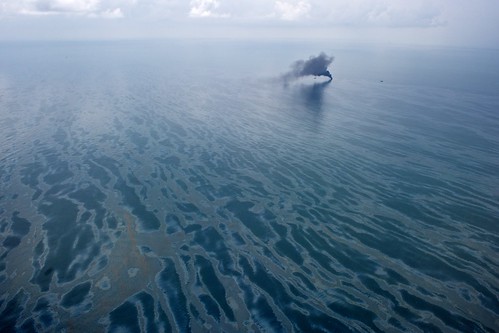
The United Houma Nation, a Native American tribe living on the Gulf Coast in southeast Louisiana and already suffering serious consequences of the spill, are hosting a cultural exchange with their Ecuadorean counterparts. Read/listen to this National Public Radio report on the BP spill's impact on the Houma tribe: Native American Group Hit Hard By Oil Spill. Photo of burning oil and oil slick on the surface of the Gulf of Mexico by James Duncan Davidson, part of the powerful TEDxOilSpill Expedition photography set.

The Amazon leaders will tour areas of the Bayou affected by the spill, have community exchanges with the Houma and other Gulf coast residents, and participate in a public Town Hall forum in the heart of the largest Houma community this coming Thursday evening.

Today, with the support of Amazon Watch's Clean Up Ecuador Campaign and our allies at Rainforest Action Network's Change Chevron campaign, the Ecuadorean leaders released a report, entitled The Lasting Stain of Oil: Cautionary Tales and Lessons from the Amazon.

The report begins:

While BP and the United States Government work to stop the oil that continues flowing into the Gulf of Mexico, coastal residents are preparing for the long-term impacts of the oil spill, and working to determine how they will maintain their environment, culture, and livelihoods in the wake of such a disaster. What can Gulf Coast residents learn from other communities that have suffered the terrible consequences of oil industry recklessness?

The report contains ten lessons from the Ecuadoreans' experience with Chevron that Gulf Coast residents – and others affected by oil spills – can learn from in order to hold polluters accountable, and design strategies for recovery from environmental disasters. Here is the first of the ten sections:

1. Public Awareness and Support is Invaluable It took decades for communities in the remote Ecuadorean Amazon to draw the world’s attention to Chevron’s systematic pollution of the rainforest. While affected communities in Ecuador have spent years working to raise public awareness of their plight, there has thankfully been worldwide attention focused on BP’s tragic oil spill in the Gulf since day one. Gulf Coast communities have a tremendous opportunity to hold BP accountable by capitalizing on the worldwide attention this terrible tragedy has garnered. Although BP says that it plans to take full responsibility for the damages caused by its spill and restore the Gulf Coast to the way it was before – “make it right" – the experience in Ecuador shows that oil companies do the right thing only when compelled to do so by a combination of political, financial, media, and community pressure. Nearly half a century has elapsed since Chevron began oil operations in the Ecuadorean Amazon, and the company is still fighting tooth and nail to evade responsibility. Lesson: Seize the moment. With support of environmental and health organizations, affected communities must take advantage of widespread attention on the BP disaster, and make clear and strong demands now for a permanent place at the table in all decision-making about remediation and restoration of their communities and the environment.

We'll share additional excerpts from the report throughout the week but please download and read it, and share it widely.

In addition to excerpts from the report, we will be reporting from the Amazon delegation to the Gulf Coast all week, and sharing photos, video, and stories from this exchange of solidarity between front-line communities affected by oil.

Stay tuned here, and on Facebook and Twitter.

– Han

Han Shan is the Coordinator of Amazon Watch's Clean Up Ecuador Campaign