Thursday, June 12, 2014

Chevron: Release the Secret Evidence that Proves Your Guilt in Ecuador

Reposted from the The Huffington Post

In the wake of a controversial U.S. court ruling that a $9.5 billion Ecuador judgment against Chevron is fraudulent, the oil giant has been touting loudly its innocence of any environmental crimes in the South American country.

Chevron's lawyers even successfully pressured some CBS News corporate suits to yank a damning 60 Minutes piece from the network's website about the deliberate contamination of the Ecuador rainforest from 1964 to 1992 by Texaco, which Chevron later bought.

(See the dead link here. You can see the segment on my company's web site. So sue me, CBS.)

Instead of succumbing to Chevron's pressure tactics, CBS' lawyers should grow a backbone and demand to see contamination "playbook" documents that Chevron has been forced to produce in an international arbitration proceeding.

They are explosive and prove 60 Minutes got it right, and the U.S. judge got it wrong.

The playbook details how the company hid evidence of contamination during an eight-year Ecuador trial resulting in a $9.5 billion damage award that the Ecuadorians are waiting for Chevron to pay.

Meanwhile, Chevron is claiming in arbitration that the Republic of Ecuador should pay the judgment, and the two parties are duking it out before a panel of corporate trade lawyers who rent office space at The Hague and act as "judges" – more about them later.

The playbook took center stage in a recent arbitration filing by Ecuador. It appears the country's lawyers have gotten their hands on much, if not the entire, playbook, but the corporate trade lawyers are requiring Ecuador to redact or cover up the really damning evidence.

Even so, a recent rejoinder filed by Ecuador reveals enough to demonstrate what a morally bankrupt company Chevron is. (See the redacted rejoinder here.)

Here's what we know about the playbook, pieced together from the filings of both the Ecuadorians in U.S. court and the Republic of Ecuador in arbitration.

In 2011, the Ecuadorians obtained a few pages from the playbook and tried to enter them into evidence during Chevron's "fraud" trial, but Federal Judge Lewis Kaplan refused to allow any evidence of contamination into the record, including the small excerpt from Chevron's playbook.

(See my recent blog about this legal travesty, and this earlier 2011 press release about the playbook.)

During the Ecuador trial Chevron's paid experts wrote the playbook to document how to handle the contamination they found at the well sites in soil and water tests.

Without the knowledge of the Ecuador court, Chevron's experts conducted unofficial and secret pre-inspections of the sites so they could avoid the badly contaminated areas during the official judicial inspections. (See page 63 in the rejoinder.)

Their pre-inspection findings would have been devastating to their case had they been turned over to the court. So they never were. (See page 63.)

Instead, they used the results to avoid the contaminated areas and test at clean spots, usually from soil and water at elevations higher than the huge, unlined and open pits Texaco built to store permanently pure crude and toxic water.

[Quick backgrounder: Texaco explored for oil in Ecuador from 1964 to 1992 and was the sole operator of the well sites during that time. The Ecuadorians filed their original lawsuit in the U.S. against Texaco in 1993, one year after Texaco left Ecuador. A U.S. judge dismissed their lawsuit ruling in 2001 at Texaco's urging the litigation should be heard in Ecuador. That year, Chevron bought Texaco. In 2003, the Ecuadorians re-filed their case in Ecuador but not before the U.S. 2nd Circuit Court of Appeals instructed Chevron that it must accept Ecuador's jurisdiction, which it did.]

Chevron routinely used deceptive methods, such as mixing clean soil with dirty and undercounting hydrocarbons, to hide or reduce toxic chemicals in samplings. (See pages 66-72.)

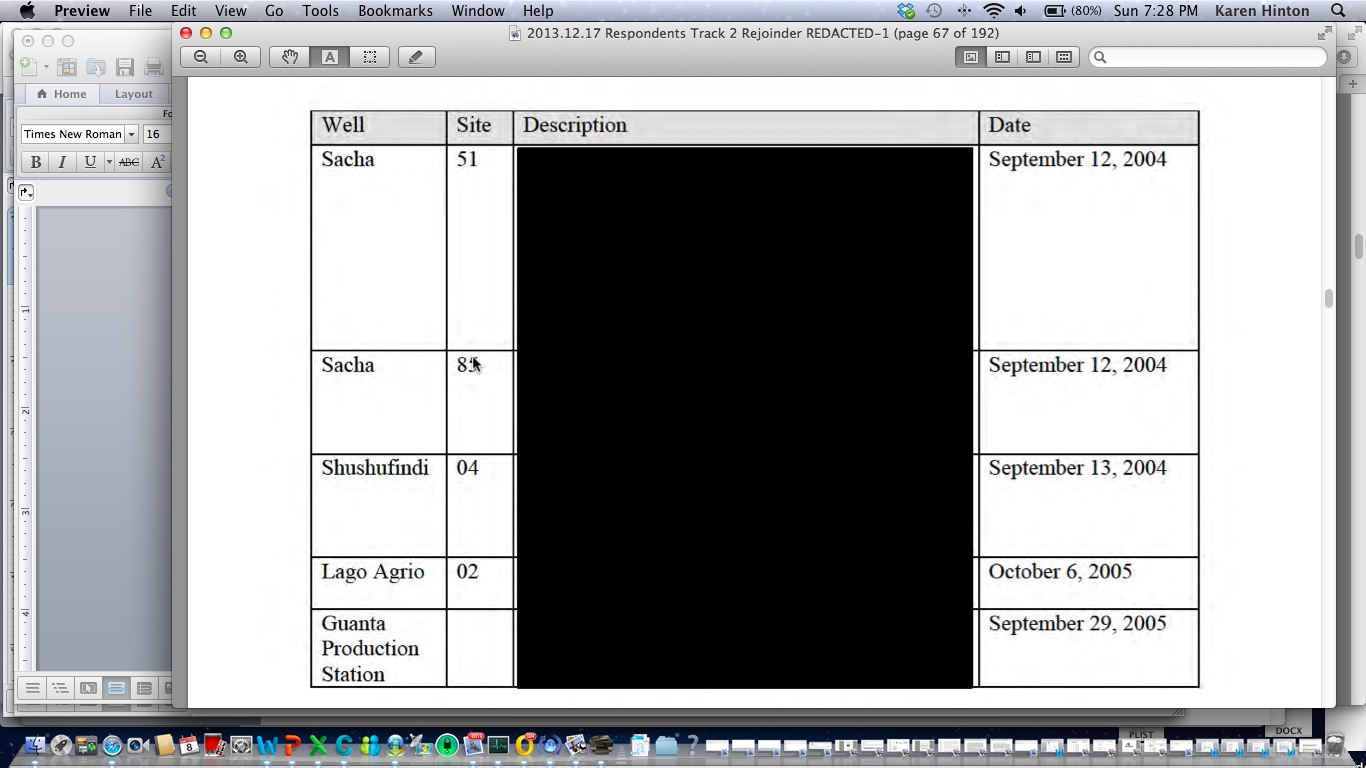
This table below, taken from the arbitration filing, reflects just a few of the thousands of pages of playbook notes Chevron's experts and field personnel took, describing the contamination and advising the company about ways to avoid it during the official judicial inspection.
2014-06-11-blogchart.jpg

It's heavily redacted. If it's true – as Chevron says it is – that the oil giant is innocent, and the truth is what it seeks, then why won't Chevron release the un-redacted, unedited playbook for all to see?

Maybe it has something to do with the 1995 remediation agreement that Chevron argues is its get-out-of-jail-free card.

The agreement, between Texaco and the Republic of Ecuador, released Texaco from government liability in exchange for a cleanup of a relatively small number of pits. It did not, however, release Texaco from third-party claims.

During the Ecuador trial, tests found contamination levels at the so-called remediated Texaco pits as high or higher than the ones not cleaned. The Ecuadorians accused Texaco of simply throwing dirt on top of the contamination to hide it.

Chevron's playbook backs that up.

At pits Texaco said it cleaned, Chevron – according to its own playbook – found contamination during its secret PIs or pre-inspections. To avoid or reduce the contamination Chevron, during the official judicial inspection, took soil only from the top layer.

Ecuador's rejoinder references the playbook notes of Shushufindi 24, Sacha 21 and Lago Agrio 6, all three well sites that Texaco said it cleaned.

In its secret, pre-inspections Chevron discovered otherwise. (See pages 68-69.)

The rejoinder reads: "During the JIs (judicial inspections) Chevron's experts sought to avoid finding pollution by sampling only to depths that it knew to be clean. For example, at Shushufindi 24, the soil boring log at pit 2 shows that during its PI, (pre-inspection) REDACTED "Then at the JI, Chevron strategically chose to take surface soil samples only – avoiding the known contamination below."

Chevron: What did you find at Shushufini 24, Sacha 21 and Lago Agrio 6?

If you found little or no contamination, then all is well.

If you found contamination and withheld it from the court, then your remediation agreement comes unraveled as does your entire legal case.

Chevron will say today that pre-inspections were allowed, but that's not what its attorneys said during the trial. Chevron wrongfully accused the Ecuadorians of pre-inspections, telling the court that pre-inspections were a "violation of legal security and due process of law," and "no technical team from ChevronTexaco Corporation has performed any secret tests here."

The rejoinder reads:"Yet by that time, Chevron's experts had conducted PIs at least REDACTED (number of) sites and taken over REDACTED (number of) samples." (See page 65.)

Chevron wants its shareholders to believe the Ecuadorians are history, even though enforcement lawsuits are underway in three countries and an appeal of the U.S. ruling is pending before the Second Circuit Court of Appeals, which reversed an earlier Kaplan attempt to stop enforcement of the Ecuador judgment.

And, while the Republic of Ecuador is fighting aggressively Chevron's arbitration claim, it is doubtful the arbitration panel will rule against the oil giant.

Brought in 2009, Chevron's arbitration action is based on alleged violations of Ecuador's Bilateral Trade Agreement with the United States.

For some time now, multi-national corporations have been abusing these trade agreements. Allowing it to happen are the corporate trade lawyers who sit on arbitration panels as judges and then rotate off as lawyers representing corporations before panels composed of their trade lawyer buddies.

Best example is the successful claim by Phillip Morris against Australia because the country placed warning signs on cigarette packs about the dangers of smoking after Phillip Morris began selling cigarettes there. See here.

International arbitration is fraught with serious conflicts of interest, and some countries are considering ending bi-lateral trade agreements due to numerous upside down arbitration rulings that have put the interest of corporations above a country's residents.

The Ecuadorians' best bet is in Canada, Brazil and Argentina where they have filed enforcement lawsuits to seize Chevron's assets in those countries as payment for the judgment.

Who knows? The entire Chevron playbook may see the light of day in one of those courtrooms soon. Or, 60 Minutes could stand by its work and demand to see it.

Ironically, during Chevron's "fraud" trial, Kaplan quoted former Supreme Court Justice Louis D. Brandeis' famous maxim that "sunlight is said to be the best of disinfectants" but when it comes to the allegations leveled by the Ecuadorians and their lawyer, Steven Donziger, Kaplan and the corporate trade lawyers hanging out at the Hague prefer the dark side of the moon.

– Karen Hinton

Wednesday, May 28, 2014

"Who's Bribin' Who?"

Donny Rico (and Chevron) explain how to pollute the Amazon and get away wit' it.


Reposted from the Eye on the Amazon

Do people give people backpacks full of cold hard cash in exchange for legal testimony? People do. Chevron should know. They did exactly that.

Chevron's effort to avoid responsibility for one of the world's largest oil disasters and sink the $9 billion guilty verdict against it delivered by Ecuadorian courts – and upheld on three occasions – comes down to one man: Alberto Guerra. A corrupt ex-judge, he became Chevron's star witness in the company's RICO lawsuit against the Ecuador rainforest communities and their council. In testimony in U.S. Federal Court in New York, he testified that he had received a backpack full of cash in exchange for his testimony, along with a monthly stipend of $12,000 USD, a home, a car, and a crack legal team to get himself – and his family – political asylum in the United States. Pretty good deal for a guy who admitted to accepting bribes as low as $200.

The tale is eloquently told by corporate thug Donny Rico in his latest episode.

But of course you won't be hearing John Watson mention that today as shareholders gather for the company's annual general meeting in Midland, Texas. Watson will be touting the recent decision from Judge Kaplan's kangaroo court in New York against the Ecuadorians as the silver bullet that saved Chevron from liability for one of the world's most egregious environmental and human rights crimes. But Kaplan's decision – based almost entirely on Guerra's testimony – is on appeal before the Second Circuit in New York that overruled Kaplan before on the Ecuador issue.

But does the decision do what Watson claims it will? Does it insulate shareholders from risk? As has been written, Chevron is not out of the woods yet, and the Ecuadorians are not out of options. Chevron's problems under Watson go beyond the courtroom – to the court of public opinion.

Another liability that will likely be unmentioned by Watson is last week's global #AntiChevron day. In a sign that the fallout from the company's poor environmental and human rights record worldwide is spiraling out of control, some 20 actions occurred on five continents. Importantly, many of these were in communities where Chevron has existing operations, seeks to expand, or plans new exploration – critical to adding new reserves and increasing shareholder value. And while he can throw millions at lawyers and PR firms to continue to run from the Ecuador issue, the liability continues to rear its head in Canada, Brazil, and beyond.

Another major problem that Watson will surely sidestep is the increasing campaign of the Ecuadorian government to pressure Chevron to do the right thing. While the company has consistently dismissed it, there's a certain geopolitical reality that isn't good for Chevron. It can't be good for business to have Ecuador's President, Rafael Correa, widely considered the new leader of Latin America's left (who is in the process of changing the constitution to allow indefinite re-election), chumming it up with the presidents of UNASUR and ALBA countries about how Chevron drilled, dumped, and ran. In particular, Venezuela and Argentina represent both the company's largest operations in South America and its biggest new upstream investment, respectively.

Watson thought he would find solace in the wilds of west Texas by moving the meeting and thereby avoiding the protests in the Bay Area which have confronted him year in and year out. But even in oil-friendly, middle-of-nowhere Midland, affected community members found him. Humberto Piaguaje, a Secoya indigenous leader and representative of the network of affected communities said, “Wherever they go, we will be there, because the crime Chevron committed in Ecuador is unforgivable.”

To help shareholders cut through Watson's smokescreen at today's meeting, we turn it over to Chevron crony Donny Rico for a true rendering of how Chevron got an Ecuadorian judge to do its bidding.

Thursday, May 22, 2014

What Happens When an Oil Company Actually Chooses to Be a Sociopath? #AntiChevron Day


Reposted from the Eye on the Amazon

You gotta give Chevron's management credit for bringing people together – across oceans, continents, and borders. Not because the company is a good neighbor; quite the opposite. Communities on five continents who live where Chevron operated, operates, or seeks to operate, came together yesterday in a worldwide day of protest to denounce the oil giant's environmental and human rights practices.

May 21st, the inaugural International #AntiChevron day, marked a new chapter in the company's deteriorating relationship with the communities where it works and a major challenge to its brand as concerned citizens in twenty countries pledged to target Chevron products. Despite what senior management is saying from behind their rose-colored glasses, it was a referendum on the company that seems slated to grow unless Chevron changes course. But time and again, Chevron management has made major strategic miscalculations, whose effects can now be seen literally around the globe. (for a list of organizations and communities in solidarity with these movement, look here).

Chevron has truly become the poster child for crimes against the environment and human rights. The bizarre thing is that their management chose that mantle and they appear to be sticking with it.

When Chevron (operating as Texaco) made the choice to save $3 per barrel by designing oil extraction systems which deliberately dumped billions of gallons of toxic waste into the pristine Ecuadorian rainforest, they never imagined that they'd one day be found guilty and ordered to pay $9.5 BILLION for it. A very bad calculation. Not too long after that initial choice, they doubled down and rejected pleas to safely line the growing number of waste pits, stating that $4 million was too high a price to avoid poisoning local communities.

Later, Chevron calculated they could delay and eventually derail the decades-long legal battle in New York and then Ecuador. They blew that calculation, too. Not once did they listen to the math lessons given to them by concerned shareholders, government officials, indigenous communities, the environmental and human rights community – it's more costly in the long run for everyone if you refuse to do the right thing and clean up your messes.

The current Chevron CEO, John Watson, is by no means solely responsible, but his math skills may be worst of all. After helping to orchestrate the Chevron-Texaco merger (despite full knowledge of its massive liability in Ecuador), Watson has led the company down the path to its current status as an international pariah. He did this by insisting that rather than accept its clear responsibility for environmental destruction in Ecuador and elsewhere, the company should attack, overwhelm and crush its critics wherever they are. And, tellingly, it then spent millions on ad campaigns telling the world that Chevron cares, because Chevron knows that is where it's most vulnerable.

On May 21, 2014, it became clearer than ever that Chevron's choices are going to come back to haunt them – with financial consequences (the only kind they actually care about). You see, yesterday people were outraged in Argentina, where Chevron has considerable assets – and is investing more. They were protesting in Romania, a key location for Chevron's plans to expand its fracking operations. They were in the streets in Bulgaria, Brazil, and Bolivia, too. And pretty much throughout Europe: the UK, Spain, France, Germany, Austria, Switzerland, Belgium, Sweden. And lets not forget Australia and the Philippines; yes protests took place there, too.

These actions took place because communities living with Chevron's deliberate environmental destruction and human rights crimes in Ecuador, Nigeria, Argentina, Romania and Richmond, California ASKED for them. Because it's obvious to anyone paying attention that Chevron's actions wherever it operates are a growing threat to human rights and the environment everywhere. That Chevron has as little regard for democratic principles in Romania as it does in Richmond. That Chevron's abuse of the rule of law in Ecuador is a dangerous threat to workers in Australia. They all see that Chevron is not just an irresponsible oil company and poor “global citizen” – its behavior is akin to a sociopath's: antisocial, often criminal, and that lacks a sense of moral responsibility or social conscience with no signs of remorse or reform.

Chevron smugly announced that it has no assets in Ecuador and so it will never pay what it owes to the 30,000 Amazonian inhabitants it poisoned. But it does hold quite a lot of assets in Canada. And yes, protests took place there, too. Indeed, Chevron's strategy in the Canadian judicial system may be the next example of poor calculating as the Ecuadorian's efforts to seize assets progress there.

Next week, Watson will sit in front of shareholders, take their questions and face four separate resolutions challenging his authority on these issues. Last year, one of the resolutions challenging Watson's authority related to the Ecuador liability garnered a whopping 37% shareholder support, representing $73 billion in company assets. This year will they begin to do the real math?

The take-home for shareholders is that while Watson can talk and tout his company's scorched earth legal tactics and attacks on victims of its own contamination until he's blue in the face at this year's AGM (and he most certainly will), yesterday's actions underscore that none of its bad boy tactics appear to be insulating it from risk, and in fact they are escalating it. There's a sea change needed, starting at the top, of corporate culture that understands that doing the right thing can also be good for business.

Looking out the window in Midland, TX, Watson won't see the hundreds of protesters he would have had he not decided to move the shareholder meeting from Chevron's San Ramon headquarters, but he won't escape the voices chanting for justice from Chevron because they now emanate from every corner of the planet.

Friday, May 9, 2014

Chevron's Ecuador Plan B

Cleaning up Chevron's contamination - with no help from the company

Reposted from the Huffington Post

The big news this week in the Chevron-Ecuador saga is the Patton Boggs settlement with the oil giant, which should not be shocking to anyone following the financial troubles of the law firm.

Patton Boggs' money problems began before the Ecuadorians fighting Chevron retained its lawyers to represent them in their legal battles with the oil company in the U.S.

What is shocking is that the Ecuadorians, who have suffered the contamination of their ancestral lands in the Amazon rainforest, have been completely forgotten.

Very few reporters writing about the settlement dealt with the issue of a law firm abandoning clients, who happen to be some of the poorest and most disenfranchised people on the planet, and then ALSO agreeing to turn over case documents so it could save itself from a demise brought on by factors having little, if anything, to do with the Ecuadorians.

(I should note that the Patton Boggs lawyers driving the decision to settle were not the lawyers who actually worked on behalf of the Ecuadorians.)

The legal community in Washington, DC and New York is brattling about this new development with no interest in what the Ecuadorians (and myself for that matter) have urged the American public via its news media to consider before passing judgment on this 20-year-old lawsuit: the vast, overwhelming evidence of culpability by Chevron's predecessor Texaco and Chevron's economic coercion against lawyers and consultants assisting the Ecuadorians.

I believe Chevron's intent is to malign (and financially destroy in some instances) anyone who has spoken out against its alleged environmental crimes or funded or worked on behalf of the contamination lawsuit. This is what the Ecuadorians' supporters here and around the world (myself included) have charged and experienced firsthand.

So when Chevron General Counsel Hew Pate called on all of the Ecuadorians' supporters to disavow their cause, after the Patton Boggs defection, we assumed some PR maven removed the "or else" from his statement.

Some legal columnists concluded that because a bunch of lawyers decided to put their economic interest above their clients' Chevron therefore was innocent.

Well, not so fast.

The Ecuadorians' U.S legal adviser and the focus of Chevron's attacks, Steven Donziger, will never win the Lawyer of the Year award but the evidence against him is either weak, coerced or paid for. (See here and here.)

The real news is not about Patton Boggs, but Chevron's alleged cover-up of the mess Texaco left behind.

Below are soil test results that Chevron doesn't want you or anyone interested in the long-running Ecuador contamination litigation to see.

Chevron submitted these results to the Provincial Court of Justice of Sucumbíos in Lago Agrio, Ecuador, on September 11, 2004. You can view other Chevron test results here.

Chevron contamination test results

These test results suggest the company's guilt and blow up its alternative narrative that it is the victim rather than the indigenous peoples and villagers living in the rainforest Texaco polluted. The Ecuadorians have made this charge in numerous court briefs.

Chevron's own independent experts took the tests during an eight-year trial in Ecuador. These experts, paid by Chevron, found high levels of harmful toxins; some are known human carcinogens. Tens of thousands of test results similar to the ones I describe here are found in the Ecuador court record. They are Chevron's documents. Not the Ecuadorians.

Based largely on Chevron's own evidence, an Ecuador court awarded the Ecuadorian villagers $9.5 billion in damages in 2011, resulting from what it said was the company's deliberate contamination of the rainforest during oil exploration from 1964 to 1992.

An appellate court and the country's Supreme Court upheld the judgment.

The Ecuadorians attempted to submit these test results and others into the record of a U.S. court, where Chevron argued the judgment was a fraud, but Federal Judge Lewis Kaplan refused their request, saying the trial wasn't about the contamination at all.

Exactly how Kaplan can rule the judgment was obtained fraudulently and not allow contamination results, I don't know how to explain.

What I do know is that Chevron's management team has refused to pay the judgment, even though the company fought relentlessly to conduct the trial in Ecuador after the villagers originally filed it in New York federal court in 1993 – yet another example of the company's subterfuge.

Because Chevron stripped most of its remaining assets from Ecuador in anticipation of losing the case, the affected villagers have filed enforcement actions in Brazil, Canada and Argentina. Chevron does have assets in those countries – substantial assets that collectively approach $20 billion in value. The villagers plan to seize enough of them to force Chevron to comply with the Ecuador judgment so they can conduct a long-awaited cleanup of their sacred ancestral lands.

Chevron says these courts do not have jurisdictional authority (the Ecuadorians argue otherwise) but no court that respects the rule of law will let the oil giant off the hook, when it sees these contamination tests.

The vast majority of test results from the Ecuador trial support what the villagers in the former Chevron concession area always have alleged: Chevron contaminated their land, using substandard drilling practices to minimize costs and maximize profit. See this video.

Along with Chevron's independent experts, the technical experts for the affected communities and numerous court-appointed experts found high levels of total petroleum hydrocarbons. TPH is a measurement of toxic and, in some cases, carcinogenic chemicals and metals in soil.

Ecuador law allows 1,000 parts per million of TPH in residential areas, while, guess what? – Chevron argues that 10,000 TPH should be the limit. That's 100 times more than in the United States where many states allow only 100 TPH.

Why is 10,000 TPH protective enough for Ecuadorians – in Chevron's estimation at least – but not for Americans?

Chevron's tests also reveal that the oil giant has obfuscated to both U.S. and Ecuador courts about its main line of defense: the 1995 remediation agreement with the Government of Ecuador. The Ecuadorians argue the agreement did not release Chevron from liability, but even if it had, Chevron's own test results show that the remediation itself was inadequate at best and, most likely, fraudulent.

For example, Chevron's tests from well sites Sacha 94 and Sacha 57 show illegal contamination, even though Texaco said it cleaned them. Chevron can't blame anyone but Texaco for this environmental damage: Texaco alone built and closed these sites.

At these sites Chevron found up to 8700 TPH levels – almost 9 times greater than permitted under Ecuadorian law and evidence that Texaco did not clean the well sites adequately, if at all. There are many just like these with even greater TPH levels.

Texaco, it seems, simply poured dirt over oil pits to mask their danger. And, if lying about the cleanup wasn't bad enough, many villagers built their homes near or on the sites because they believed they had been cleaned.

Chevron's experts also found illegal amounts of benzene, barium, cadmium, lead and other chemicals in the environment – all toxic and dangerous to human health. For example:

Benzene: 18 mg found at the Sacha Norte 2 well site; Ecuador law allows only 0.05 mg. Benzene is a colorless liquid made mostly from petroleum; it is also a known human carcinogen.

The CDC says this about benzene:

"Long-term exposure to benzene can cause cancer of the blood-forming organs. This condition is called leukemia ... The Department of Health and Human Services (HHS) has determined that benzene is a known carcinogen (can cause cancer)."

Barium: 10,100 mg per kg, found at SSF-25; Ecuador law allows only 750 mg per kg. Barium is a metal used as drilling mud during oil exploration.

The CDC on barium:

"Eating or drinking very large amounts of barium compounds that dissolve in water or in the stomach can cause changes in heart rhythm or paralysis .... Some people who did not seek medical treatment soon after ... have died. (Some who ingest smaller amounts) ... may experience vomiting, abdominal cramps, diarrhea, difficulties in breathing, increased or decreased blood pressure, numbness around the face, and muscle weakness."

Cadmium: 4.1 mg per kg found at Sacha 18 well site; Ecuador law allows only 1 mg. Cadmium is a mineral that enters soil, water and air as a result of oil exploration.

The CDC on cadmium:

"Breathing high levels of cadmium can severely damage the lungs. Eating food or drinking water with very high levels severely irritates the stomach, leading to vomiting and diarrhea. Long-term exposure to lower levels of cadmium in air, food, or water leads to a buildup of cadmium in the kidneys and possible kidney disease. Other long-term effects are lung damage and fragile bones. HHS and the International Agency on Research of Cancer have determined that cadmium and cadmium compounds are human carcinogens."

Lead: 294 mg per kg, found at SSF 25; Ecuador law allows only 80 mg per kg. Lead is a metal that enters soil, water and air through oil exploration.

The CDC on lead:

"The main target for lead toxicity is the nervous system, both in adults and children.... Lead exposure may also cause weakness in fingers, wrists, or ankles. (It) also causes small increases in blood pressure, particularly in middle-aged and older people. Lead exposure may also cause anemia. At high levels of exposure, lead can severely damage the brain and kidneys ... and cause death.... The HHS has determined that lead and lead compounds are reasonably anticipated to be human carcinogens based on limited evidence from studies in humans and sufficient evidence from animal studies, and the EPA has determined that lead is a probable human carcinogen."

Reporters who have been covering the long-running litigation know these tests exist. But they don't write about them. Many say they are simply too difficult for their readers to understand. Others say they are boring.

That is exactly what Chevron is counting on: that the news media, the courts and members of the public interested in the case will never learn of the overwhelming scientific evidence against the company but instead will focus on the sensational and largely baseless allegations of fraud and bribes, backed by tainted and corrupt testimony paid by Chevron or extorted via economic pressure.

It looks like crying "fraud" in the face of the overwhelming evidence against it was Chevron's Plan B from the beginning.

Wednesday, April 30, 2014

In Long-Fought Victory for Anonymous Email Users, Chevron Agrees to Withdraw Google and Yahoo! Subpoenas

Chevron Intelligence Agency?

Reposted from EarthRights International

After more than a year and a half of litigation, Chevron has withdrawn subpoenas issued to Google and Yahoo! and agreed to end its efforts to obtain private usage and identity information associated with email accounts belonging to activists, attorneys, journalists and others who have spoken out against the company.

In September 2012, Chevron issued sweeping subpoenas to Google, Yahoo! and Microsoft in connection with its RICO lawsuit in New York against the Ecuadorian villagers and their lawyers who won a $9 billion judgment against the company in Ecuador for massive pollution in the Amazon. The subpoenas sought identity information and nearly a decade of IP login and usage information about the holders of more than 100 email accounts.

ERI, along with the Electronic Frontier Foundation (EFF), represented the owners of 37 email accounts, arguing that the subpoenas infringed their First Amendment rights to speak anonymously and associate freely and appeared to be an effort to intimidate Chevron's critics and chill future speech about the company. None of the individuals represented by ERI and EFF were defendants in the underlying RICO lawsuit.

Magistrate Judge Cousins in the Northern District of California ultimately quashed the Google and Yahoo! subpoenas for all but seven of our clients' email accounts. ERI and EFF appealed the decision on behalf of the remaining seven accounts. Recognizing the First Amendment interests at stake, the Ninth Circuit Court of Appeals ordered Yahoo! and Google not to turn over any information to Chevron about six of the seven remaining accounts until it had time to decide the appeal, but allowed Chevron to obtain limited information about the one remaining account.

In the Northern District of New York, however, Judge Kaplan—the same judge who presided over the RICO trial in the Southern District of New York, sitting by designation—refused to quash the subpoena issued to Microsoft. ERI and EFF appealed the decision, but Judge Kaplan ordered Microsoft to turn over the Hotmail account information immediately, including four accounts owned by clients of ERI and EFF, before the Second Circuit could weigh in on whether the information should have been protected from discovery.

With oral argument approaching in both appeals, Chevron agreed earlier this month to withdraw the Google and Yahoo! subpoenas and drop its pursuit of information about email accounts owned by clients of ERI and EFF. While Chevron's lawyers had already obtained account information for five of our clients' accounts, Chevron agreed that all the information it has obtained so far will be remain confidential and not made public or used in unrelated cases. Chevron did not and will not obtain any information about the owners of the other 32 email accounts represented by ERI and EFF.

The settlement and Chevron's withdrawal of the subpoenas is a victory for the individuals who have fought for more than a year and half to defend their First Amendment rights and protect their private information against Chevron's abusive discovery requests. We are proud to have been able to assist in that fight and to have ultimately succeeded in protecting the rights of more than 30 activists, lawyers, journalists and other brave individuals who stand up to corporate power and speak out against injustice around the world.